At the Grassroots of Democracy
November 13, 2025 | Nicole Frawley-PanyardWhat Michigan's Local Leaders Are Seeing
At a moment when national politics can feel increasingly polarized, a new report from the University of Michigan suggests a more hopeful story unfolding much closer to home. For 16 years, the Michigan Public Policy Survey (MPPS) has been gathering the perspectives of local government leaders across every corner of the state, from large city mayors and county administrators to township supervisors and clerks in rural communities. With a remarkable 70% response rate, the survey offers one of the most comprehensive, long-running views of how democracy is actually working on the ground.
“We talk about democracy at the national level all the time,” said Debra Horner, program manager of the MPPS at the Center for Local, State, and Urban Policy (CLOSUP). “But local governments are where residents experience democracy most directly. It’s the level of government we hear the least about, but where the quality of democratic life is often strongest.”
A Rare Window into Local Democratic Life
Unlike many surveys that track voter behavior or partisan trends, the MPPS listens to the public servants who actually run local institutions—those who oversee elections, facilitate public meetings, plan infrastructure, manage budgets, and respond when residents call. Because many officials participate year after year, the survey offers a living timeline of how leaders’ perceptions evolve alongside political, economic, and social changes.
As Horner puts it, the MPPS represents “a massive accumulation of data on perspectives and insights about democratic governance at the local level.”
What Local Officials Are Seeing
Since 2020, the MPPS has asked officials to evaluate the functioning of democracy at three levels—national, state, and within their own local community—using a broad definition that includes free and fair elections, rule of law, ethical governance, balanced power, constructive discourse, press freedom, and civic participation.
Two patterns stand out.
First, local democracy is holding up better than democracy at the state or national level. Many officials report that collaboration, communication, election integrity, and community trust remain strong locally, even as confidence in national institutions continues to erode.
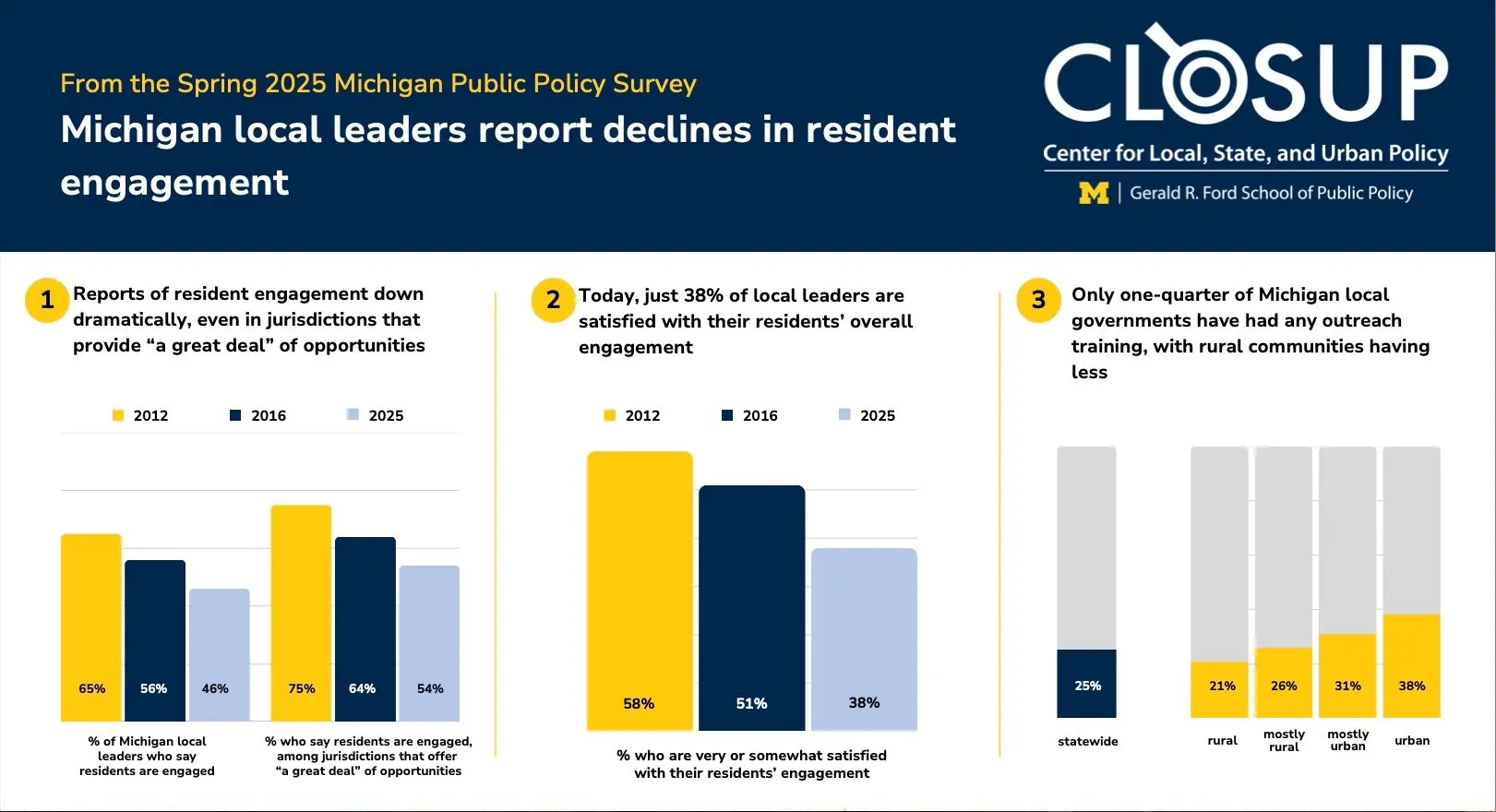
Second, resident engagement is slipping. Despite expanded outreach and new participation tools, fewer local officials are satisfied with how involved residents are in public life compared to a decade ago.
How Can Democracy Be “Strong” Amid Declining Engagement?
At first glance, it might seem contradictory that local officials report both declining civic participation and strong local democracy. However, researchers note that the survey’s question about “functioning democracy” encompasses far more than engagement alone.
Respondents are asked to consider factors such as free and fair elections, rule of law, transparency, ethical governance, and an informed electorate. From that broader perspective, democracy can still function well even if fewer residents are directly involved.
Horner explains that confidence in local elections has actually improved since 2020, aided by Michigan’s new election processes, such as same-day registration and expanded absentee voting. These positive trends may help offset concerns about declining participation. Notably, increases in perceived democratic health are strongest among Democrats, Independents, and urban officials, while Republicans and rural leaders tend to report steady confidence rather than gains.
Another report, to be released later this semester, will examine trends in trust and civic discourse. A spring 2026 report will focus specifically on challenges to recruiting community members to run for local office or serve on government boards.
Building Capacity and Sharing the Data
With support from U-M’s Year of Democracy initiative, the MPPS team has:
- Conducted a 2025 survey examining local efforts, challenges, and ideas on resident engagement.
- Updated a statewide Democracy Compendium summarizing all democracy-related findings from the last decade.
- Prepared shareable data sets for researchers so that faculty, students, and partners can analyze trends without compromising anonymity for survey respondents.
- Planned a statewide event for February that will bring local government leaders together to discuss engagement challenges and solutions.
“Our priority is always to be useful to communities,” said Stephanie Leiser, faculty lead at CLOSUP. “This survey is not just data we collect. It is a bridge between the university and the people who lead communities across Michigan, many of whom would otherwise have no direct connection to U-M at all.”
Why It Matters Now
While headlines often focus on division and dysfunction, the MPPS paints a more complex and hopeful picture. It shows a democracy that is not simply failing or thriving—but evolving. Local governments remain the most trusted and functional arenas of democratic life, even as they grapple with lower participation and growing polarization.
“At the national level, things can look grim,” Horner said. “But when you focus on cities, villages, and townships, you see democracy still working. That is the story we think deserves more attention.”

Stephanie Leiser