What Our Workplaces Reveal About Political Division and Why It Matters
January 8, 2026 | Nicole Frawley-PanyardWorkplaces as One of the Last Politically Mixed Spaces
In an era where Americans increasingly live, socialize, and get news in politically like-minded circles, one place still brings people with different political identities together: the workplace. Yet even there, new research suggests that political separation may be more widespread than we think, shaping not only how we collaborate but also how we participate in democracy.
With support from the Initiative for Democracy and Civic Empowerment, a research team led by Justin Frake, assistant professor at the University of Michigan’s Ross School of Business, has compiled one of the largest datasets ever created linking voter registration and employment records. The dataset covers more than 20 million Americans. The goal is to better understand how Democrats and Republicans sort into different workplaces, how political identity shapes opportunities inside organizations, and how coworkers influence one another’s civic engagement.
A New Way to Measure Political Sorting at Work
The project began with a straightforward but previously impossible question: Where do people with different political identities work? Frake notes that we have known for decades that genders and racial groups tend to be clustered in certain industries and occupations. Political identity, however, had not been studied at this scale because the necessary data did not exist.
Using a new dataset scraped from public LinkedIn profiles, combined with public voter registration files, the team developed what they call VRscores: a measure of the partisan balance inside individual workplaces and industries. Rather than classifying an employer by the political donations of its executives, VRscores capture the political identity of employees themselves.
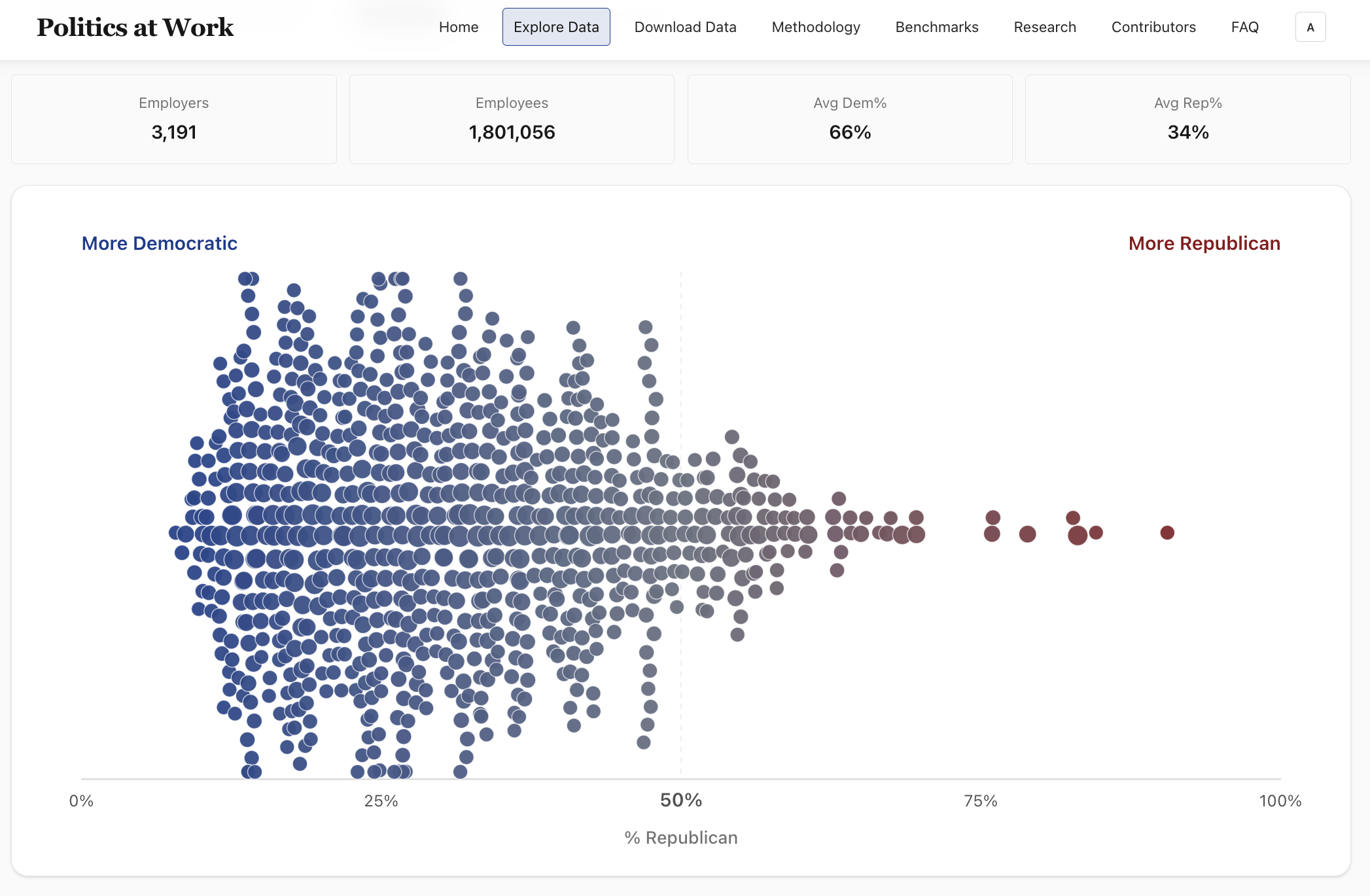
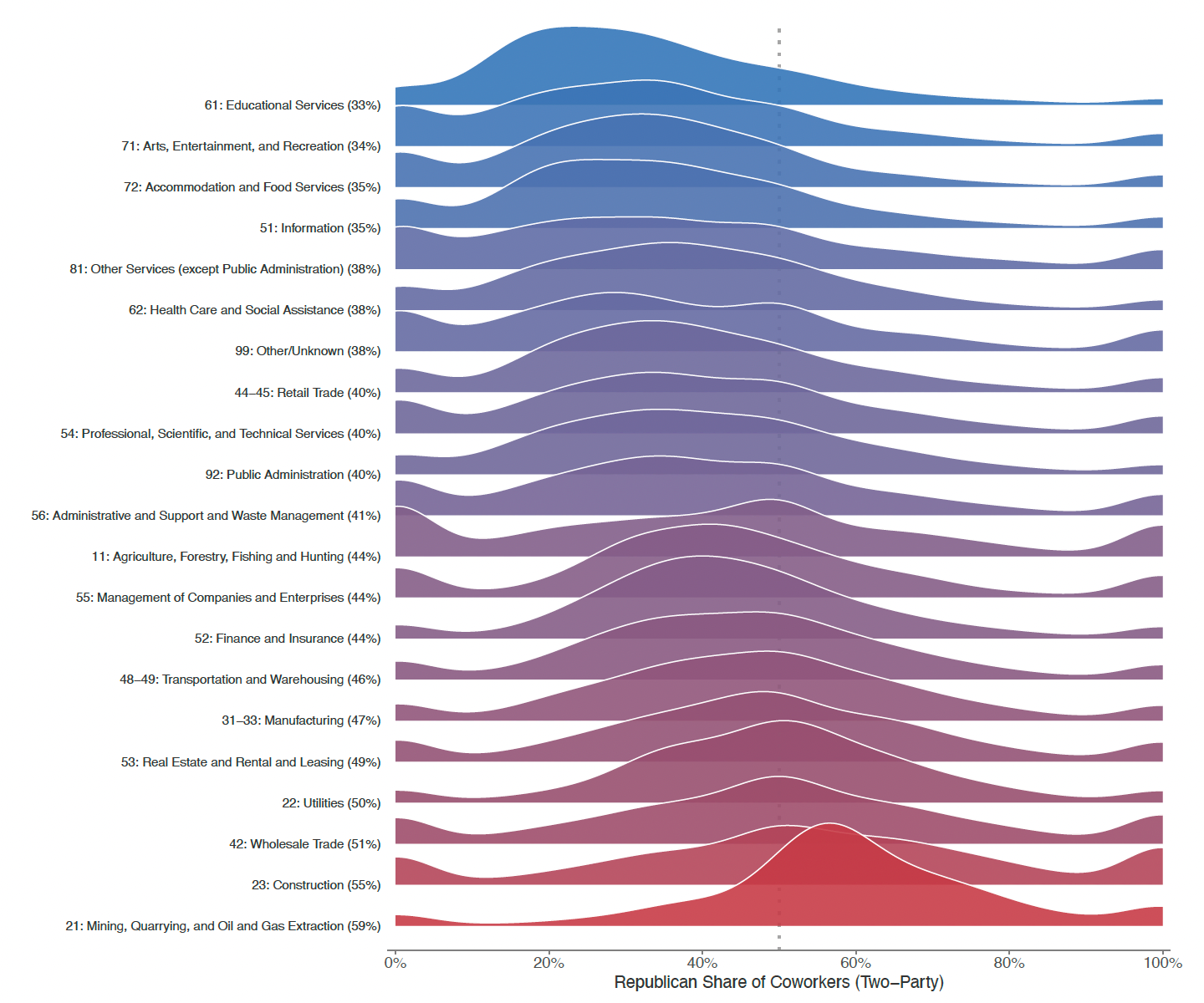
The results indicate that political sorting in the workplace is as strong as sorting by gender. For instance, oil and gas companies tend to employ more Republicans, while education and nonprofit organizations tend to be more Democratic. Even within the same industry, employees often cluster into politically like-minded firms, which means people may encounter less ideological diversity at work than expected.
How Workplaces Influence Civic Participation
However, the workplace does not simply reflect political identity. It can shape it. In a second study, researchers examined whether a person’s likelihood of voting changes based on the turnout habits of coworkers. They found that employees are more likely to vote when surrounded by coworkers who regularly vote. In other words, workplaces can be a powerful site of civic influence.
The next major phase of the project will explore how aware people are of the political identities of their coworkers, and what happens when that information becomes more explicit. Frake and his team are preparing a survey-based field experiment in which participants will be asked how much they know about their colleagues’ politics. Then, some respondents will receive anonymized data about the actual partisan composition of their workplace, including leadership.
“We want to understand how knowledge or assumptions about coworkers’ politics affects workplace behavior,” Frake said. “Do people withdraw? Does it change trust or collaboration? Does it affect how employees view their employer’s values?”
The researchers plan to release refreshed public data every four years, aligned with national election cycles. Early findings suggest that promotion patterns may differ depending on whether an employee shares the political identity of organizational leadership.
“At a time when many Americans worry that partisan division is pushing us further apart, workplaces may be one of the last remaining spaces where cross-party interaction consistently happens,” Frake said. Understanding how political identities function in these environments may help us design organizations, and perhaps communities, that support respectful and constructive civic engagement.
“We are hoping to help people see workplaces not only as economic institutions, but also as democratic ones.”