

Past Events Archive
Year of Democracy Featured Events
-
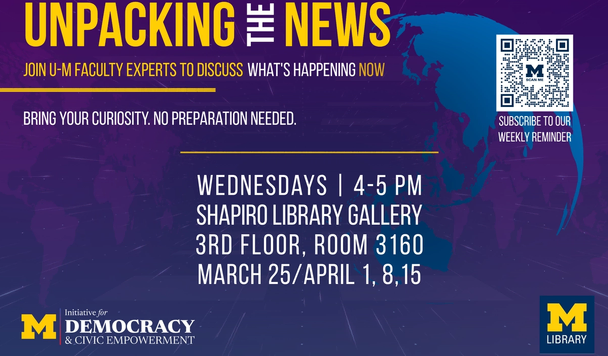
Unpacking the News
April 1, 2026 | 4:00-5:00PM | Shapiro Library Gallery, 3rd floor, Rm 3160
Each session offers a space to pause, sort out what’s happening, and engage in thoughtful, civil discussion with peers. Bring your questions, your curiosity, and your perspective—no preparation required.
-
Sankofa: Honoring the Past to Strengthen Future Democracy (SCOR 2026 Social Justice Symposium)
April 1, 2026 | 10-12PM | Great Lakes Room, Palmer Commons
The Students of Color of Rackham (SCOR) are excited to welcome you to the 2026 Social Justice Symposium: “Sankofa: Honoring the Past to Strengthen Future Democracy.”
More about this event
This event seeks to explore a central question: How can university communities draw upon their histories of activism, advocacy, and democratic participation to build a more equitable and inclusive future?
-
Dinner for Democracy: How to Be a Good Follower of Local Politics
March 26, 2026 | 6:00-7:00PM | Earl V Moore Building Rm 1378
Dinners for Democracy are nonpartisan presentations and small group discussions on topics students care about, hosted by the student organization, Turn Up Turnout (TUT). Free dinner is provided! Participants can expect to gain a deeper knowledge of the issue and an opportunity to discuss their thoughts, information about how their vote in local offices can affect the issue, and additional resources they can use to learn more.
-
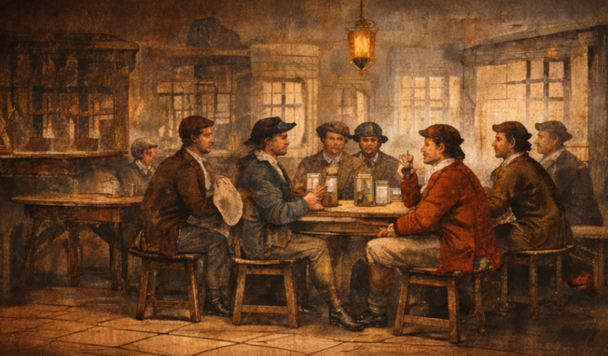
Taverns and the Post-Revolutionary Republican Experiment
March 26, 2026 | 4:00-5:30PM | Hatcher Graduate Library
In Accommodating the Republic: Use of Taverns in the Early United States, Kirsten Wood explores how Americans' use taverns in their pursuits of happiness helped flesh out the evolving meaning of citizenship in the young United States.
More about this event
In this talk, she looks at the years following the Revolutionary War, when Americans continued to use their neighborhood taverns as sites for gathering and political mobilization. The scope and significance of practices that had been so central to the revolutionary struggle shifted in the early republic, as Americans wrestled with the promise and problems of republican self-government. Although the mid-nineteenth-century temperance movement would soon frame tavern-going as the habit of dangerously shiftless men, in the republic's early decades, entrepreneurial, improvement-minded men—and some women!--went to taverns to raise capital, promote innovative businesses, practice genteel sociability, and put republican self-government into practice.
-
Unpacking the News
March 25, 2026 | 4:00-5:00PM | Shapiro Library Gallery, 3rd floor, Rm 3160
Each session offers a space to pause, sort out what’s happening, and engage in thoughtful, civil discussion with peers. Bring your questions, your curiosity, and your perspective—no preparation required.
-

Facilitating Dialogue Using Circle Processes
March 25, 2026 | 12:00-1:30pm | North Quad 2435
As we navigate an increasingly complex social and political landscape, the need for robust democratic engagement has never been more vital. At its core, democracy thrives not just through the ballot box, but through our ability to foster discourse, practice inclusive decision-making, and build resilient communities.
More about this event
On behalf of the Dialogue Michigan planning team, we invite U-M faculty and staff to join us for our next event, where we will explore a practical tool for this civic work.
Democratic engagement requires us to move beyond debate and toward dialogue. Circle processes provide a structured way to do exactly that and to be in community. Rooted in First Nation and Indigenous peacemaking practices, these processes create an egalitarian space where:
- Every voice is centered: The use of a talking piece ensures that all participants have the space to be heard without interruption.
- Power is shared: The circular structure removes traditional hierarchies, encouraging collective responsibility and transparency.
- Community is restored: It offers a framework for navigating conflict and making decisions that reflect the needs of the whole, rather than just the majority.
This workshop will be interactive, providing you with the opportunity to experience a circle firsthand and learn how to bring these restorative practices into your work and community spaces.
Registration required: https://sessions.studentlife.umich.edu/p/track/16802
LEARN MORE ABOUT DIALOGUE MICHIGAN
https://myumi.ch/dialogue -
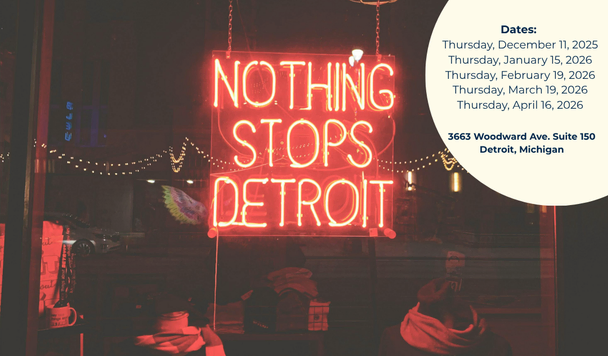
Workshop of Democracy: Police Reform and Community Violence Interventions
March 19, 2026 | 10-12PM | 3663 Woodward Ave, Suite 150, Detroit MI
This panel explores police reform and community violence strategies used in Detroit, with experts and residents discussing ways to improve safety
and trust.
Workshop of Democracy: Join us for a dynamic series of panels and workshops showcasing how Detroiters have responded to 21st century challenges, developed innovative strategies and driven policy change—offering inspiring examples of grassroots power in action.More about this event
Too often Detroit has been viewed as a site of social and economic problems, and not as a source of solutions or strategies for the future. With partners at Bridge Detroit, the University of Michigan Detroit Center is hosting a series of public panel discussions exploring the struggles and achievements of local grassroots movements who have confronted the challenges of the 21st century–from food deserts and environmental racism to gentrification and violence–with the grit and spirit of innovation that defines the spirit of the Motor City. Come join the conversation, and learn the lessons that Detroit has to teach the nation and the world
-
Pro-Social Design with Pluralistic and Narrative AI Systems
March 19, 2026 | 6:00-7:30PM | Dana Building, 440 Church St
This talk will present two complementary lines of work that explore how AI systems can be designed to serve pro-social outcomes not by collapsing social diversity into a single voice, but instead surfacing pluralism and by making abstract societal issues more personally meaningful.
More about this event
First, I will discuss Plurals, a system that uses multi-agent deliberation to simulate socially diverse ensembles rather than a single neutral model output. Plurals provides a flexible framework for configuring agents, interaction structures, and moderation strategies inspired by deliberative democracy. Across multiple case studies and experiments, we show that simulated social ensembles can produce outputs that better resonate with real audiences than standard single-model generation.
Second, I will introduce an ongoing line of work that explores AI-assisted narrative autocompletion as a tool for reducing psychological distance to complex societal issues. This work uses interactive, personalized narratives co-written with users to help people imagine how distant or abstract events could plausibly unfold in their own lives.
Taken together, these projects illustrate two complementary strategies for AI in society: one that emphasizes pluralistic deliberation across perspectives, and another that leverages narrative imagination to connect individual experience with collective outcomes.
-
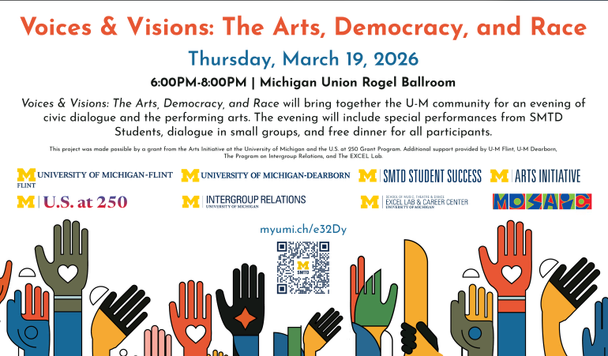
Voices & Visions: The Arts, Democracy, and Race
March 19, 2026 | 6:00-8:00PM | Michigan Union - Rogel Ballroom
Voices & Visions: The Arts, Democracy, and Race will bring together the U-M community for an evening of civic dialogue and the performing arts.
More about this event
The evening will include special performances from SMTD Students and The Mosaic Youth Theater of Detroit, dialogue in small groups, and free dinner for all participants.
This event is in partnership with The SMTD Student Success Office, U-M Dearborn, U-M Flint, The Arts Initiative, USA at 250, The SMTD EXCEL Lab, and The Program on Intergroup Relations.This project was made possible by a grant from the Arts Initiative at the University of Michigan and the U.S. at 250 Grant Program. -

Unpacking the News with Professor Pasek
March 18, 2026 | 4:00-5:00PM | Michigan Union, Parker Room
Join a weekly, student-centered conversation that takes a closer look at major news events shaping the world.
More about this event
Each session offers a space to pause, sort out what’s happening, and engage in thoughtful, civil discussion with peers. Bring your questions, your curiosity, and your perspective—no preparation required.
Josh Pasek is Professor of Communication & Media and Political Science, Faculty Associate at the Center for Political Studies, Institute for Social Research, and Associate Director of the Michigan Institute for Data Science at the University of Michigan